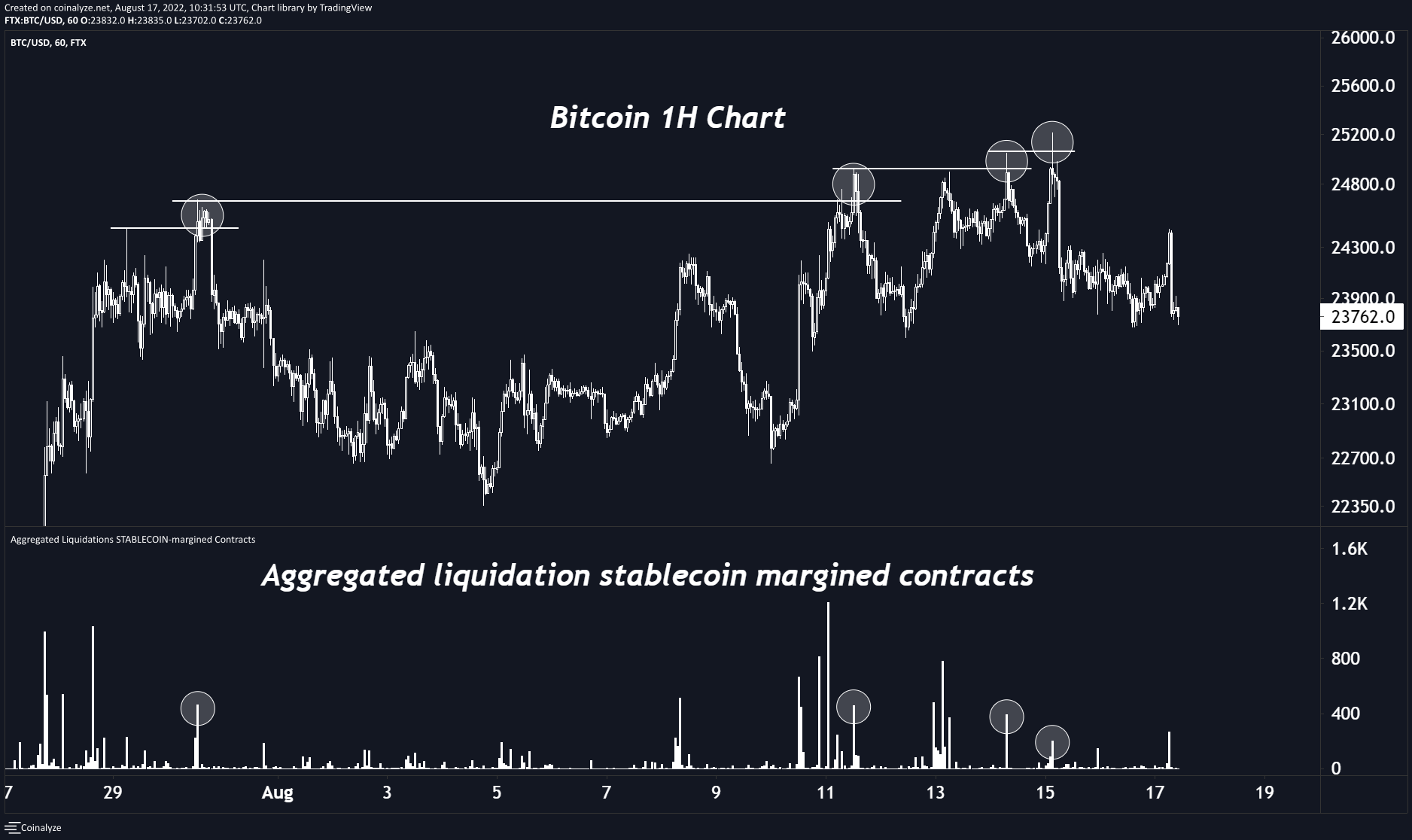
 This is when shorts are pushed out of their positions because they don’t have sufficient margin to collateralize them.
Because technicals are the primary tool for crypto market participants, those participants will often set their invalidation levels just beyond support and resistance levels.
As a result, whenever the market puts in a high or a low, often there will be a lot of untapped liquidity beyond these levels where traders have set their stops.
Smart money knows this, and it takes advantage of the supply/demand extremes of these forceful selling/buying events, pushing prices beyond support and resistance levels.
In this case, whenever price wicks above these previous highs, all the countless traders who set their invalidations above these levels using technical analysis have to cover their shorts by buying back their position.
And all this liquidity allows smart money with lots of capital to execute their trades and profit from the supply and demand extremes.
This SFP aspect is put on full display when we consider the liquidity delta of legacy markets to cryptocurrencies. It’s far easier for a large trader to swing prices in an altcoin to liquidity zones than it would be in Apple or the S&P 500.
If you don’t believe that this type of trading happens, BitMEX quite literally used the SFP nature of technical analysis to regularly contribute to price wicks and liquidation cascades:
This is when shorts are pushed out of their positions because they don’t have sufficient margin to collateralize them.
Because technicals are the primary tool for crypto market participants, those participants will often set their invalidation levels just beyond support and resistance levels.
As a result, whenever the market puts in a high or a low, often there will be a lot of untapped liquidity beyond these levels where traders have set their stops.
Smart money knows this, and it takes advantage of the supply/demand extremes of these forceful selling/buying events, pushing prices beyond support and resistance levels.
In this case, whenever price wicks above these previous highs, all the countless traders who set their invalidations above these levels using technical analysis have to cover their shorts by buying back their position.
And all this liquidity allows smart money with lots of capital to execute their trades and profit from the supply and demand extremes.
This SFP aspect is put on full display when we consider the liquidity delta of legacy markets to cryptocurrencies. It’s far easier for a large trader to swing prices in an altcoin to liquidity zones than it would be in Apple or the S&P 500.
If you don’t believe that this type of trading happens, BitMEX quite literally used the SFP nature of technical analysis to regularly contribute to price wicks and liquidation cascades:
 This kind of short-term trading isn’t our game. But the action does support SFP when it comes to cryptocurrencies.
If you want to trade in these short-term time frames, a little knowledge of order flow and liquidation data goes a long way to ensure you’re not getting constantly faked out on your invalidations.
Even when we venture outside of short time frames, this price action happens all the time. It’s not isolated to intraday action, and stop hunts are made much easier considering the ample liquidity traders set below support and resistance levels.
Let’s recap the points we’ve discussed so far:
This kind of short-term trading isn’t our game. But the action does support SFP when it comes to cryptocurrencies.
If you want to trade in these short-term time frames, a little knowledge of order flow and liquidation data goes a long way to ensure you’re not getting constantly faked out on your invalidations.
Even when we venture outside of short time frames, this price action happens all the time. It’s not isolated to intraday action, and stop hunts are made much easier considering the ample liquidity traders set below support and resistance levels.
Let’s recap the points we’ve discussed so far:
- Technical analysis in crypto much closer represents a self-fulfilling prophecy than its operation in legacy markets. In this sense, I’d argue that “classic” technical analysis is less accurate in crypto than in legacy markets because everyone’s doing it. It’s not that technical analysis doesn’t work; you just have to be mindful of these additional factors.
- The primary element driven by SFP in technical analysis of cryptocurrencies appears to be support/resistance trading. This is arguably the most objective and universal application of technical analysis and is thus the most susceptible, as shown by constant liquidity-hunting in these zones.
If you enjoyed this post and want access to our premium cryptocurrency research, start your
30-day risk-free trial.Thanks for reading, and please let us know if you have any questions! Allstarcharts Team