It’s a bull market, in case you haven’t heard.
As such, I’m on the hunt for alpha. I’m looking for stocks that might be off the radar, but can have outsized moves when the market runs.
Today’s trade offers this potential in spades.
Expert technical analysis of financial markets by JC Parets
It’s a bull market, in case you haven’t heard.
As such, I’m on the hunt for alpha. I’m looking for stocks that might be off the radar, but can have outsized moves when the market runs.
Today’s trade offers this potential in spades.
Selling premium is easy.
Being a premium seller is hard.
This chart perfectly encapsulates why this is true:
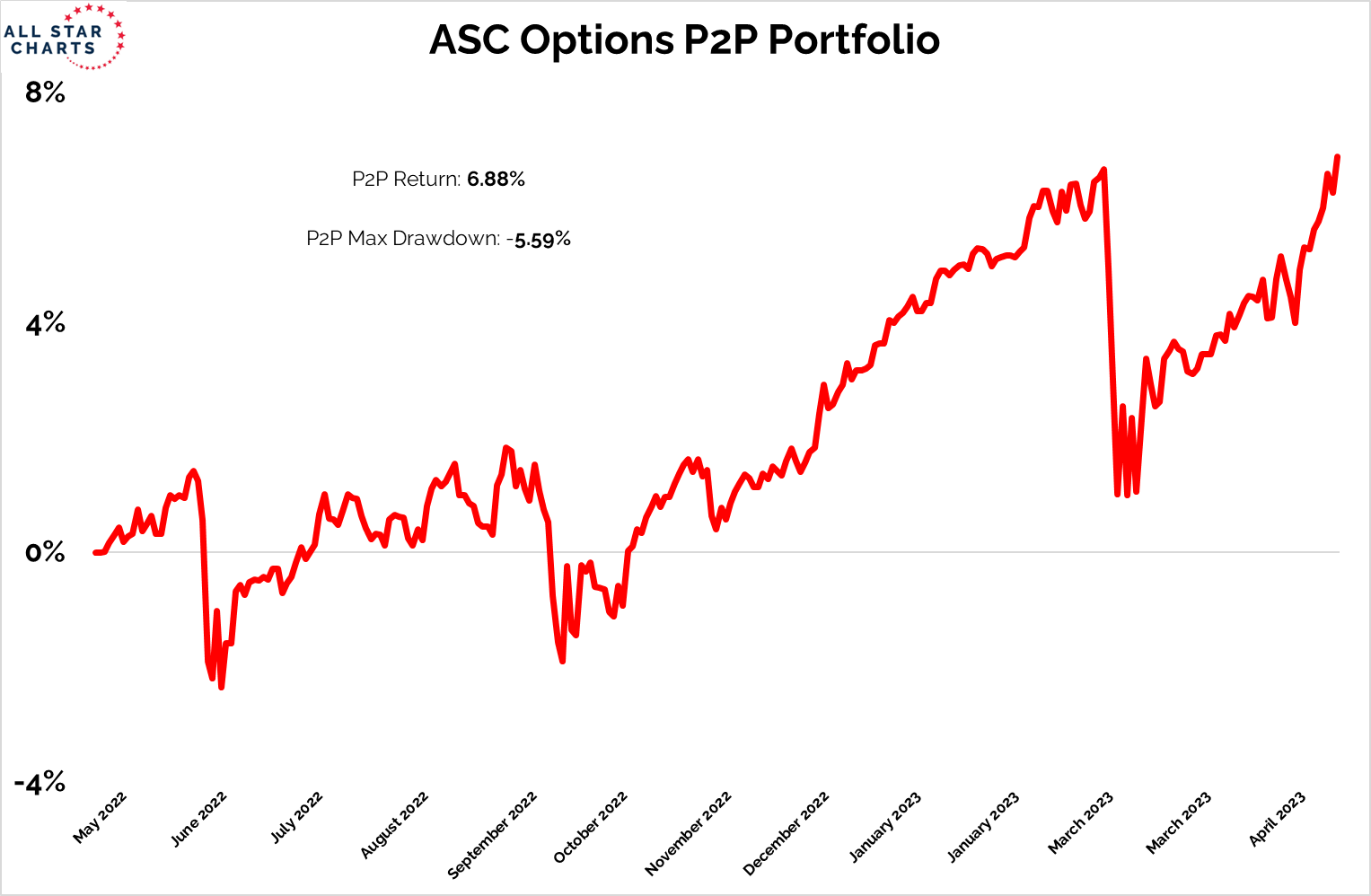
This is the one-year performance of our trading account dedicated to delta-neutral premium-selling strategies. We call it our “Paid-to-Play” or “P2P” account.
We’re making new highs, and the long-term trend is in our direction. But as you can see, the ride hasn’t always been smooth.
Selling premium is a winning strategy over the long run precisely because it’s hard. It’s hard because sitting through sudden drawdowns is hard – and many traders don’t have the stomach for it. Or they trade too big, making the PnL swings far too taxing on their emotions. Or worse, the big swings knock them out of the ring.
That big drawdown you see in March was courtesy of the regional banks blowup. Going into it, we were short a naked strangle in $KRE (regional banks) options, as well as some related positions that didn’t fare too well.
It was no fun defending those positions and staring at paper losses that eventually converted to realized losses. But the one thing that kept us in the game and continues to work for us is position sizing.
When trading strategies such as short strangles (naked short puts + naked short calls) which feature undefined risk, the best way to ensure our continued ability to participate in markets is to trade each individual position small. Being conservative is what keeps us in the game.
The reward for being conservative and sticking to our process speaks for itself.
Check out the P2P portfolio’s performance relative to two key benchmarks.
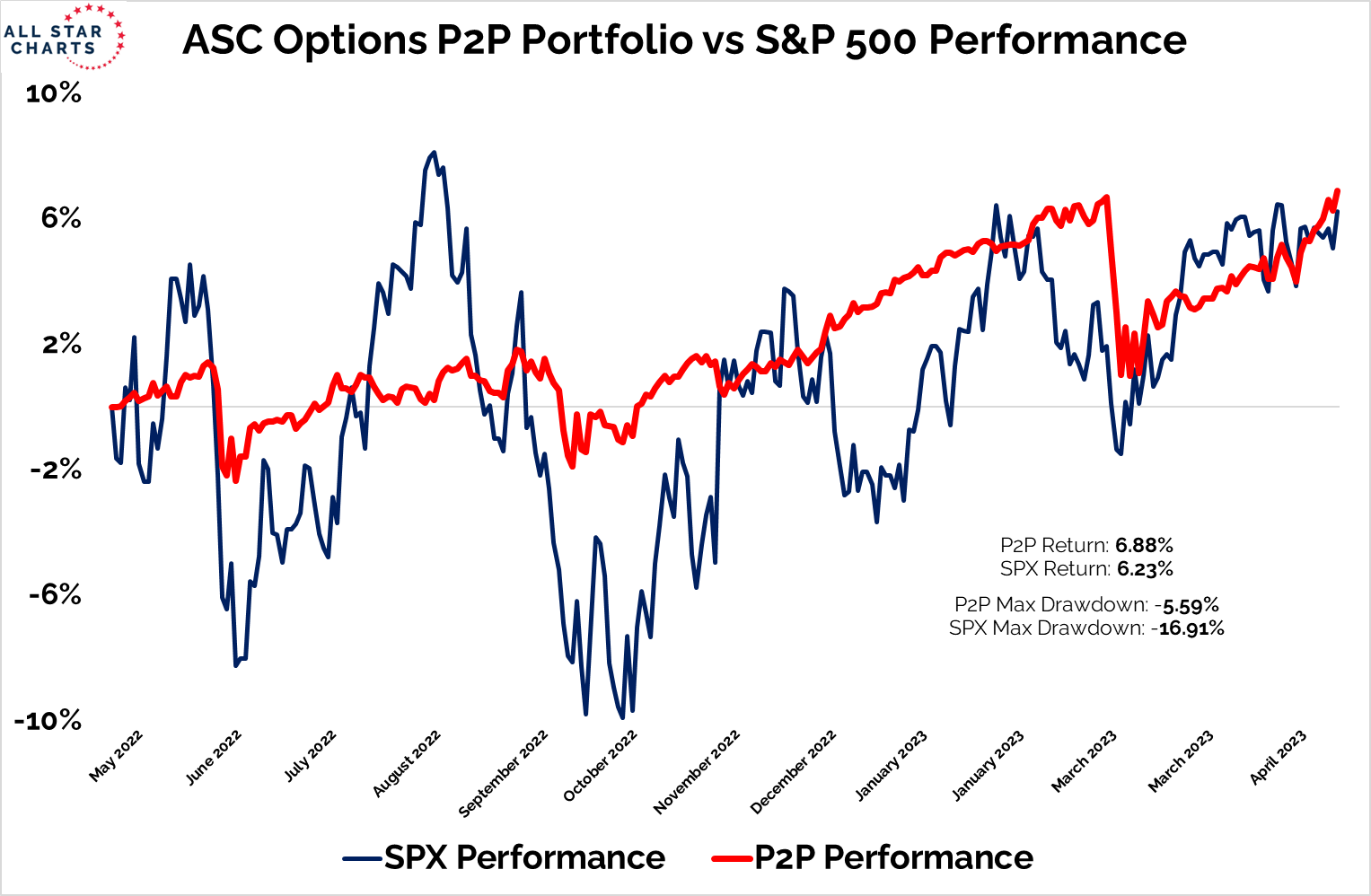
First up, the S&P 500:
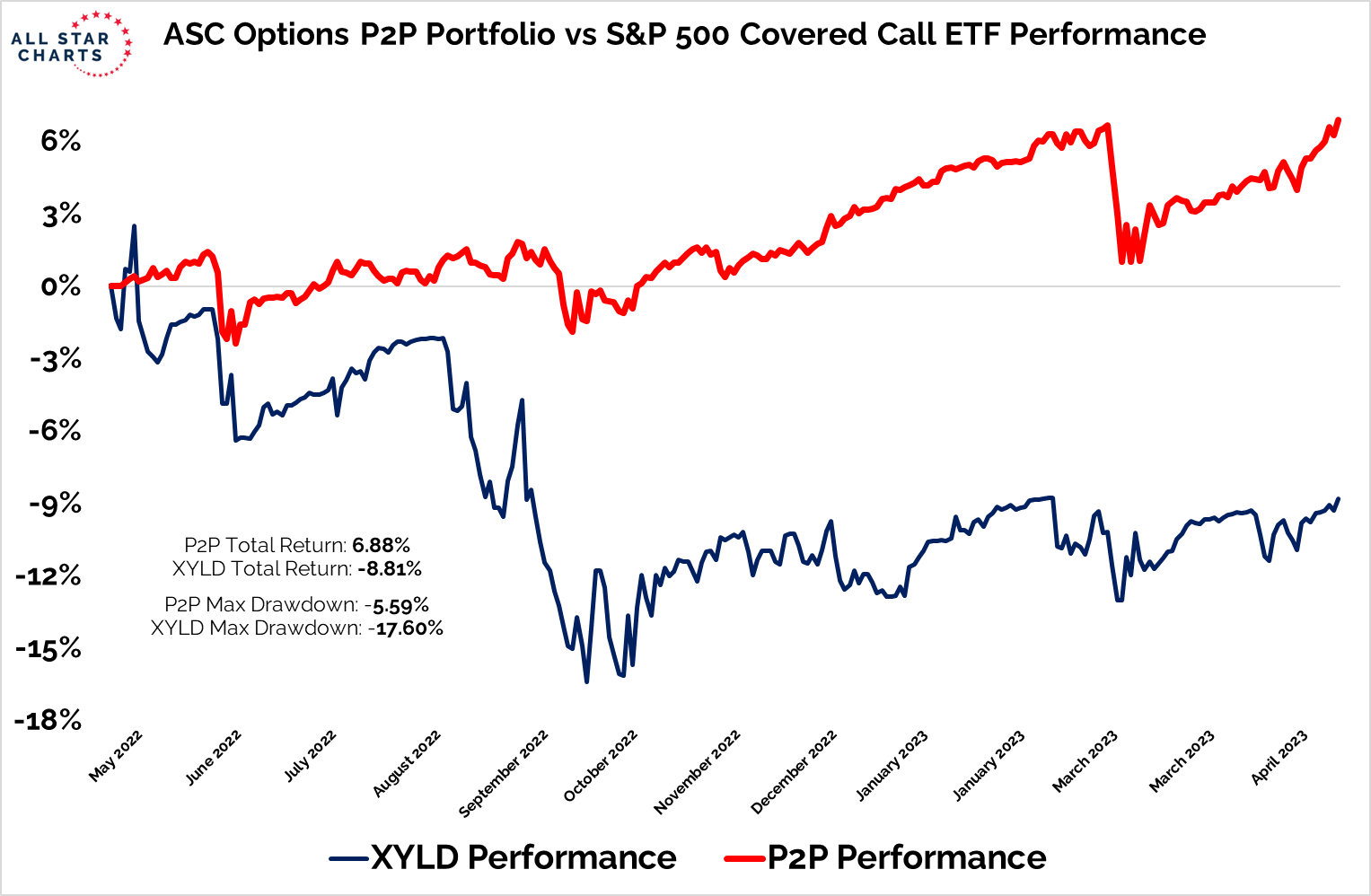
While our returns have only slightly outpaced the S&P 500, we achieved this gain with significantly less volatility. Our max drawdown of -6.23% is dwarfed by the S&P’s -16.9% drawdown during the same period.
Amateurs are seduced by total returns. Professionals focus on the risk-adjusted returns and the volatility of the ride.
Compared to the S&P 500 Covered Call ETF, there’s no contest:
It’s important to point out that our P2P Portfolio represents only a portion of our total trading assets. We are not ALL-IN on this strategy. It is only one of many that I and JC each run.
This is not meant to be a strategy to house all of our investable or tradable assets.
The true aim for a strategy like this is to provide portfolio and strategy diversification. This trading account often zigs while other accounts we manage zag. That’s what we want it to do – to provide some ballast to weather the rolling waves of the market while offering a meaningful risk-adjusted total return.
This is how we win.
If you’d like to follow along with our Paid-to-Play portfolio, you can learn more about it here.
Trade ’em Well,
Sean McLaughlin
Chief Options Strategist
All Star Charts, Technical Analysis Research
[9/7: stop moved to 260. We’re already #FreeRiding on this one. So whatever we sell the remaining position for is pure profit!]
Today’s trade leans against a significant support level that we believe will hold. But because the stock is at such a delicate level where it could quickly collapse on us if the level doesn’t hold, we’re going to keep the play simple and cleanly define our risks.
A picture is worth a thousand words, so here’s the chart of Caterpillar $CAT that’s got our attention: [Read more…]
[9/28: updated our stop to $34]
I’m filing today’s trade under the category of “Hard Trades.” Not because it’s particularly hard to execute or because it’s a complicated multi-legged spread. It won’t require an excessive amount of margin to get positioned nor is there any risk of unlimited losses.
It’s hard because people might look at the trading action of the past few days and think that it’s “gone too far” and “I should wait for a pullback.”
And traders who think that way may be right.
But here’s the thing: sometimes the best trades to get into are the best precisely because they are the “hardest” to pull the trigger on. And that’s where our opportunity is. Those of us who fight through the conventional wisdom of average traders and get positioned ahead of the crowd will be lifted later on by those same traders who were “waiting for a pullback” and put an ever-rising bid underneath our stock that fuels our future gains.
Today’s trade might be one of those setups. [Read more…]
I apologize for the victory lap, but there’s an important lesson here…
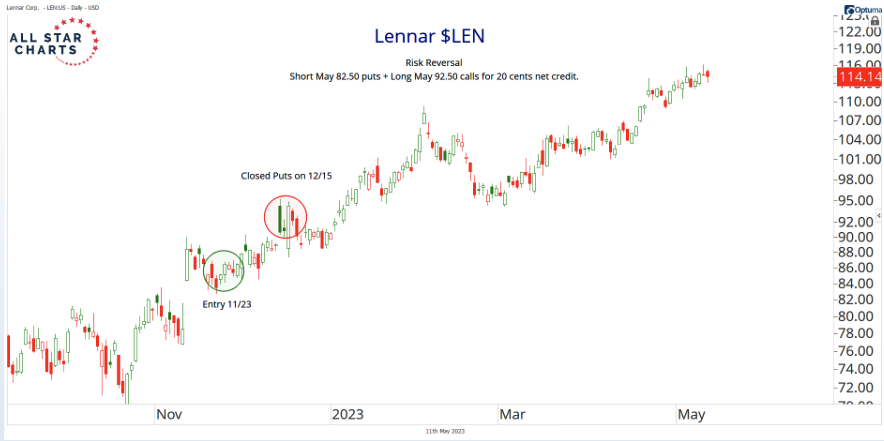
I’m approaching an exit in one of our better trades over the past year. There is only one week left until May monthly options expiration and I’m holding some deep in-the-money (ITM) calls in $LEN.
This trade started out near Thanksgiving as a bullish Risk Reversal. I sold out-of-the-money (OTM) May 82.50 strike puts on Nov. 23 and used those proceeds to purchase OTM May 92.50 strike calls. The puts were worth a little more than the calls, so the net effect of the trade was to leave me a small 20-cent credit.
I sold half of my calls Dec. 15 and used those proceeds to close all of my short puts. That trade also left with a little credit left over. It also left me holding half of my long calls with a net credit in the trade! This means that I was sitting on a guaranteed winner, with nothing but upside to gain. Sweet!
As you can see from the chart, this trade went on to perform quite well.
But this post isn’t about trade mechanics. It’s about turning off the news and following price.
In an environment where headlines were shouting about rising mortgage interest rates, overpriced homes, declining home purchases, and slowing new home builds, one would be forgiven for not being overly bullish – or even bearish – on home building stocks.
If I based my trading and investing decisions based on the evening news, coming to this conclusion would have been a rational decision.
Thankfully, I only follow price.
When it comes to finance and economics, the media talks about yesterday’s news. Price action tells the story right now. And trends and relative strength offer a hint of the future.
When I pay attention to the latter and ignore the former, good things happen for me. I don’t know any better way to do it.
As a swing trader, missing big winners is a cardinal sin. The math doesn’t work if I don’t capture occasional big wins which more than pay for all the small losses that make up the majority of my trades.
Had I let “news” tint my reading glasses, I likely would not have taken this trade, missing out on one of my biggest winners in more than a year.
Turn off the news.
Trade ’em Well,
Sean McLaughlin
Chief Options Strategist
All Star Charts, Technical Analysis Research
[9/7: updated stop to 180. We’re already #FreeRiding, so whatever we sell for is pure profit!]
It’s time for the small caps to make a stand. The time is now. If they don’t, it could be ‘goodnight’ for a long time.
JC posted earlier this week about the Russell 200 index and had this to say:
We’re back to a key level of interest for Small-caps on an absolute basis. And we’re back down to historic levels relative to Large-caps. The chart tells a very powerful story.
I’m a buyer down here.
If the Russell2000 is above last Summer’s lows, I will be long the $IWM ETF. I also think there will be plenty of opportunities this summer in small-cap stocks.
We talked about $IWM internally this morning and I suggested a good, levered way to play this thesis while honoring a nearby risk management level that will get us out of the trade without much pain if we’re wrong.
But first, here’s the chart of $IWM: [Read more…]
I make quick decisions.
Is that because I’m a trader? Or am I a trader because I make quick decisions?
Over time, I think I’ve come to the conclusion that being a trader has instilled in me a knack and preference for quick decision-making. I wasn’t always like this. 25 years of trading has taught me to work with only 75% of the information I might want, and that is good enough to take action.
The phrase “invest, then investigate,” as Stanley Druckenmiller said, comes to mind.
Outside of trading, this can also affect my day-to-day decision-making. I think it frustrates my wife when I make decisions so quickly. In her mind, she probably thinks I’m being irrational, emotional, or acting on impulse. She, in contrast, is very deliberate. Cautious. Analyzes every detail…
In my mind, I do take my time. I quietly gather information as it comes to me until I feel I’m about 75% of the way there. I’m exercising the same muscles used when evaluating risk vs. reward in my trades. If/when the potential reward is significantly higher than the risk (or significantly more likely to work out favorably versus the risk of “loss”), I strike confidently with little to no delay.
If I’m not finding opportunities to exercise these skills outside of trading, I think it’s important to do so. [Read more…]
Full Disclosure: I’m a Buffalo Bills fan. As such, I’m excited about this upcoming NFL season. This is the year! Does this fact color my interest in today’s trade? Maybe.
I get all my speculative juice in the financial markets. But there is a growing number of Americans who are jumping into online sports betting. The increases in both participation and dollars wagered is skyrocketing.
Today’s trade is a bet on a continuation of this trend that will likely be driven by the next NFL season. [Read more…]