This is the video recording of the September 8th, 2022, Weekly Town Hall w/ Willie Delwiche.
09/08/22 2:00 PM ET [Read more…]
Expert technical analysis of financial markets by JC Parets
This is the video recording of the September 8th, 2022, Weekly Town Hall w/ Willie Delwiche.
09/08/22 2:00 PM ET [Read more…]
From the desk of Willie Delwiche.
This All Star Charts +Plus Monthly Playbook breaks down the investment universe into a series of largely binary decisions and tactical calls. Paired with our Weight of the Evidence Dashboard and our Playbook Chartbook, this piece is designed to help active asset allocators follow trends, pursue opportunities, and manage risk.
From the Desk of Steve Strazza @Sstrazza
When investing in the stock market, we always want to approach it as “a market of stocks.”
Regardless of the environment, there are always stocks showing leadership and trending higher.
We may have to look harder to identify them depending on current market conditions. But there are always stocks that are going up.
The same can be said for weak stocks. Regardless of the environment, there are always stocks that are going down, too.
We already have multiple scans focusing on stocks making all-time highs, such as Hall of Famers, Minor Leaguers, and the 2 to 100 Club.
We filter these universes for stocks that are exhibiting the best momentum and relative strength characteristics.
Clearly, we spend a lot of time identifying and writing about leading stocks every week, via multiple reports.
Now, we’re also highlighting lagging stocks on a recurring basis.
Where are we in the cycle?
That’s something I like to think about.
The reason is because it helps me allocate my time better. Should I be spending more time looking for stocks to buy, should I be spending more time looking for stocks to sell, or should I be at the beach because the market is a mess?
Being able to answer this question correctly can be a huge advantage.
I think blindly incorporating a specific type of strategy at all times, regardless of the market conditions seems awfully difficult.
If we can first identify what type of market environment we’re in, then we can pick and choose which tools and strategies are best fit for that part of the cycle.
Are we in a high volatility environment? Then why would we implement strategies that are best suited for low volatility environments?
Are we in a trending market environment? Then why would we use the tools and strategies that are best for sideways rangebound markets?
I think we first identify where we are in the cycle, and then decide how to approach the market from there.
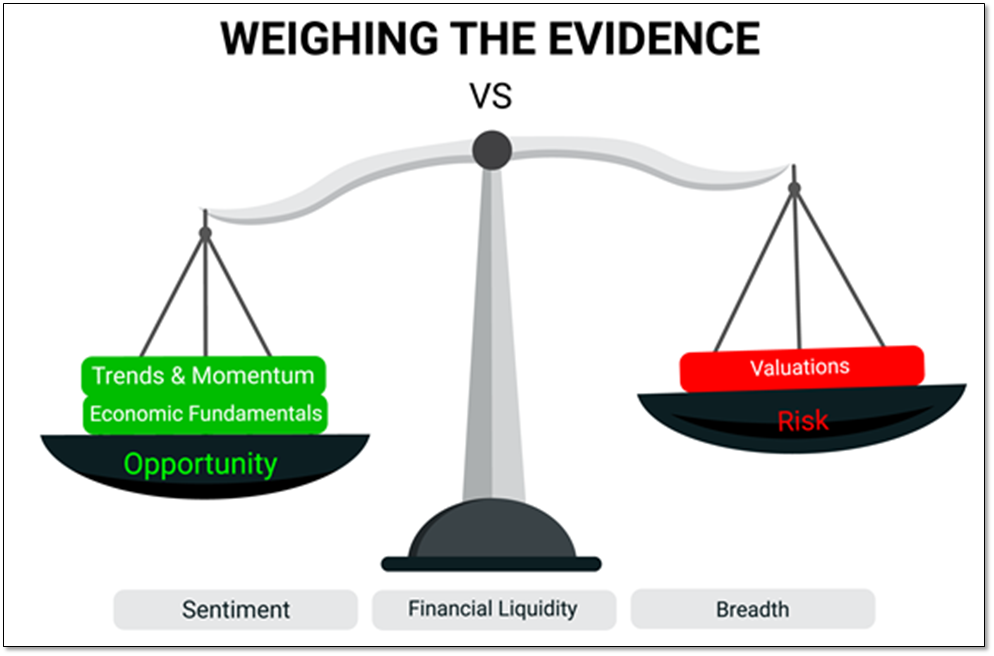
We do this by weighing all of evidence. And to be clear, I mean all the relevant evidence.
So, are we in a new bull market or what? [Read more…]
From the desk of Willie Delwiche.
Key Takeaway: Despite the stock market’s reluctance toward sustained advances, investors have refused to throw in the towel. The bulls showed up last month, declaring their intent by triggering short-term breadth and momentum thrusts. Yet, as impressive as the display of strength was, they’re still waiting for the market to respond. Or at least the response they were hoping for. We would expect oversold conditions to reverse quickly after strong upside momentum and broadening participation. That hasn’t happened yet and bulls are showing signs of getting discouraged. If the relationship between investors and stocks isn’t going to be a two-way street, the likelihood of a broader and deeper sentiment re-set increases.
Sentiment Report Chart of the Week: Investors Not Giving Up On Stocks
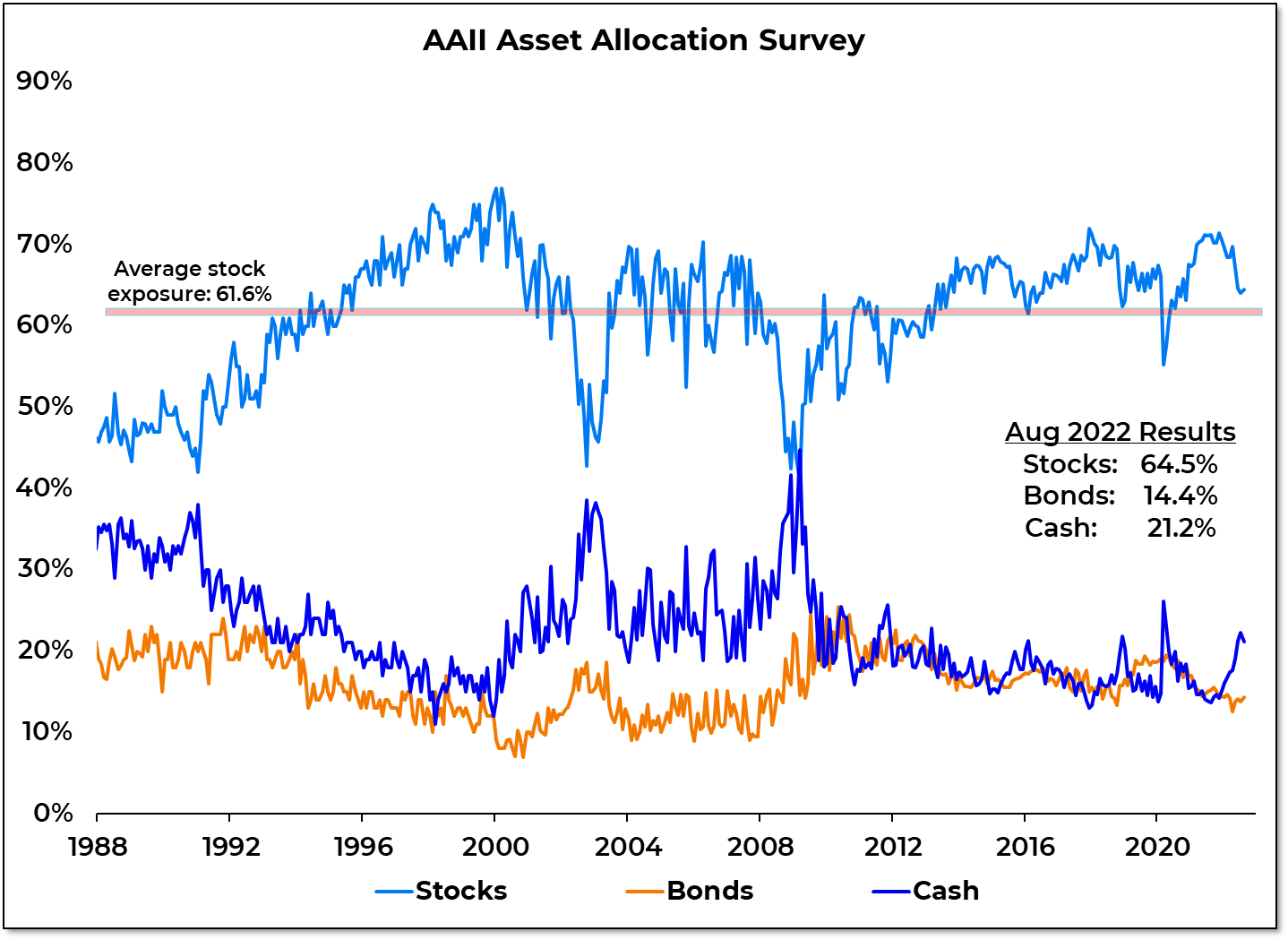
Despite financial market volatility in August and evidence of increased caution showing up in options data and sentiment surveys, investors increased exposure to both stocks and bonds. ETF flow data show $28 billion flowing into equities last month and $15 billion moving into bonds. Commodity ETFs experienced their fourth month in a row of outflows. From an asset allocation perspective, individual investors have maintained above average exposure to stocks all year. This despite the talk about the equities being unloved and sentiment being at historically low levels. The first half of this year did not see the decisive move away from stocks and toward cash that was seen during previous periods of excessive pessimism (1990, 2002, 2008, 2020). The resiliency of that love affair could be tested as the optimism that emerged off of the June lows evaporates.
After reviewing the Cyclical Portfolio, we are making the active decision to sit on our hands for now. In the Tactical Opportunity Portfolio, we’ve made a couple of tweaks. We are seeing “Higher for longer” resonate with the bond market and are increasing exposure to one of the few areas that is actually still in an uptrend.
Today’s blog title was uttered during this morning’s internal Analyst meeting by our Commodities Analyst Ian Culley.
He drew our attention to Wheat futures and the corresponding ETF in the stock market $WEAT and loves this setup for a long trade. We’re not fundamentalists here, but it’s hard not to be aware of the macro economic backdrop with inflation on the rise and food shortages looming in Europe with a cold winter on the horizon. This combined with the technical picture sets up a really nice high reward versus low-risk trading opportunity.
Here’s the chart for $WEAT:
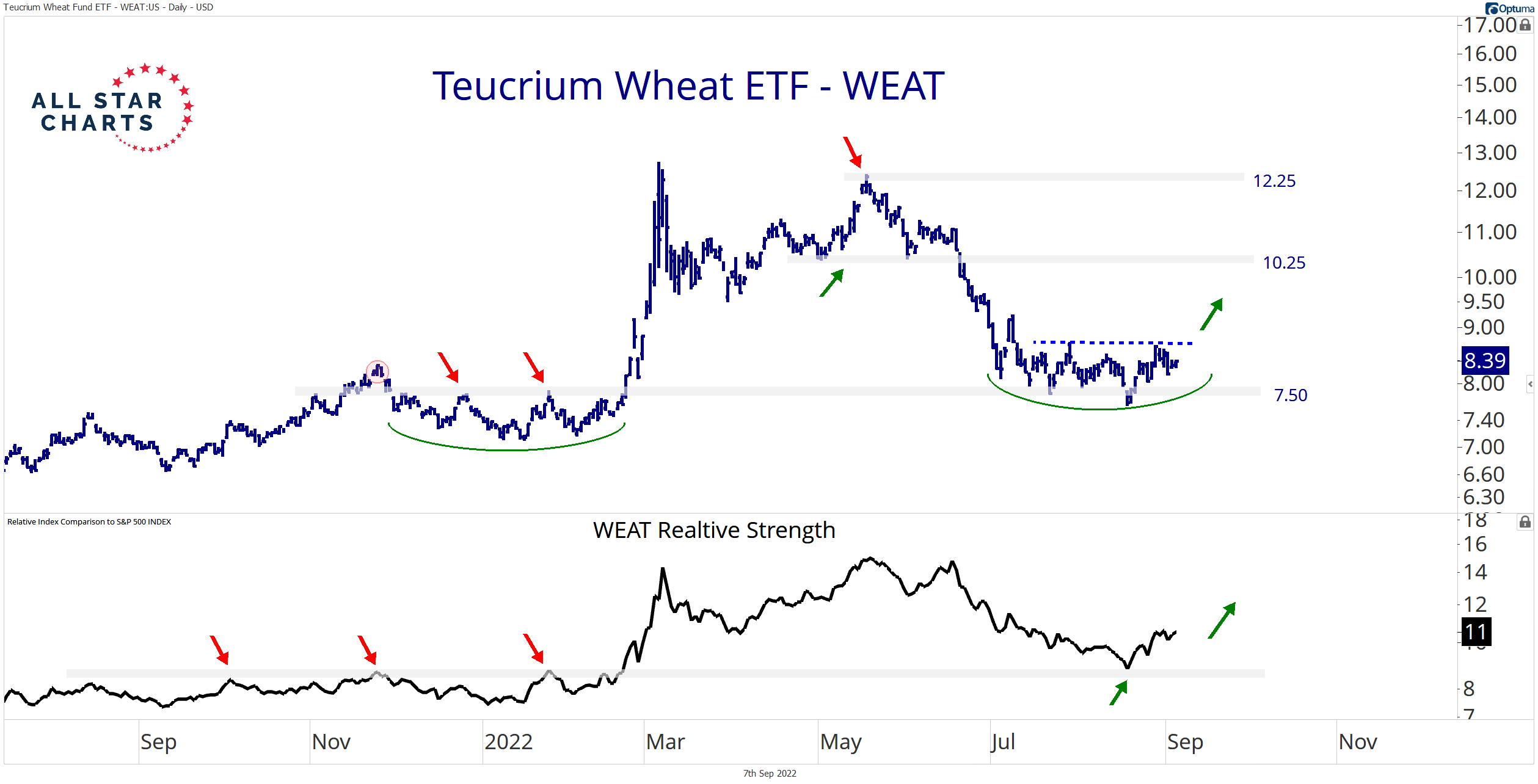 This chart is a little stale, it doesn’t show today’s trading action which thrust $WEAT above that resistance line, trading almost up to $9.00 today before peeling back, giving us a better entry.
To take advantage of this setup, we’re going to keep it simple and define our risk with straight long calls.
Here’s the Play:
We like buying January 10-strike calls for approximately 55 cents. If $WEAT makes a run back up towards that consolidation zone in the $11-12 area, then these calls will pay off nicely — perhaps a 4-5x return on our invested capital.
The most we can lose in this trade is the 55 cents in premium we pay upfront. We’ll size our position assuming that if we’re wrong we’ll lose 100%. But we’ll keep an eye on the $7.80 level for risk management. If $WEAT closes below $7.80 then we’re likely wrong in this trade and will look to exit if there’s any premium left in the options to salvage.
On the positive side, if/when this trade starts working for us, I’ll look to sell half of my position if I’ve doubled my money. Doing this will remove all of my original risk capital from the trade, leaving me a #FreeRide on the remainder.
The potential for free unlimited upside? I’d eat that!!
If you have any questions on this trade, please send them here.
ASO subscribers who missed last week’s live video Jam Session where we review activity in our options portfolio from the past week can catch it here.
P.S. We do trades like this regularly. If you’d like to leverage Best-in-Class technical analysis into smarter directional options trades, try out All Star Options Risk Free! Or give us a call to learn more: 323-421-7991.
From the Desk of Louis Sykes @haumicharts
Recently I’ve been listening to a wider variety of music than I have in the past. It’s by design.
Each week, I’ve assigned myself a little goal to listen to a new album. I set aside a few hours to actively listen and immerse myself in the music — to relax, of course, but also to consider the themes and overall messages artists are trying to convey.
It’s been fun, and I’m enjoying it immensely. And it’s also helped me become a better writer and opened my outlook on life more broadly.
Music is powerful. I can’t imagine life without it. And one particular track from my personal list of top 10 classic hip hop pieces of all time has been stuck in my head all day.