This is the video recording of the March 31st Weekly Town Hall w/ Willie Delwiche & JC Parets
03/31/22 2:00 PM ET [Read more…]
Expert technical analysis of financial markets by JC Parets
This is the video recording of the March 31st Weekly Town Hall w/ Willie Delwiche & JC Parets
03/31/22 2:00 PM ET [Read more…]
From the desk of Louis Sykes @haumicharts
Alright, time for a light-hearted story.
Over the last few months, I’ve jumped down the rabbit hole that is Crypto Twitter (better known as CT).
As someone who’s snooped around Financial Twitter (or FinTwit), a community dominated by industry professionals, CMTs, and CFAs, opening the trapdoor into CT felt similar to the culture shock I would experience moving to a new country.
Anyone that’s had a presence in CT knows the culture: anon (anonymous) accounts, constant meme-ing, and shit-posting from a community of outcasts and degenerates enjoying riding the volatility of a new generation of assets.
This carnage was the perfect breeding ground for the wassie…
From the desk of Steve Strazza @Sstrazza
Welcome to the 2 to 100 Club.
As many of you know, something we’ve been working on internally is using various bottom-up tools and scans to complement our top-down approach. It’s really been working for us!
One way we’re doing this is by identifying the strongest growth stocks as they climb the market-cap ladder from small- to mid- to large- and, ultimately, to mega-cap status (over $200B).
Once they graduate from small-cap to mid-cap status (over $2B), they come on our radar. Likewise, when they surpass the roughly $30B mark, they roll off our list.
But the scan doesn’t just end there.
We only want to look at the strongest growth industries in the market, as that is typically where these potential 50-baggers come from.
Some of the best performers in recent decades – stocks like Priceline, Amazon, Netflix, Salesforce, and myriad others – would have been on this list at some point during their journey to becoming the market behemoths they are today.
When you look at the stocks in our table, you’ll notice we’re only focused on Technology and Growth industry groups such as Software, Semiconductors, Online Retail, Solar, etc.
Then, like any good technician, we filter the list down to those closest to new highs.
This allows the cream of these strong groups to rise to the top and helps streamline our mission to identify technical breakouts in the top-performing stocks.
From the desk of Willie Delwiche.
Key Takeaway: Price action has a way of changing sentiment, and the recent bout of strength has brought signs of hope. Optimism is on the rise with an uptick in bulls, a rebound in both the II and AAII bull-bear spreads, and an increase in exposure by active equity managers. Yet, bears linger and the drop in put/call ratios is driven by decreasing put activity. This speaks to less of a risk-off tone rather than a definitive sign of risk-on behavior. Though optimism is in the air, it’s going to take further improvements in trend, momentum, and breadth for bears to change their tune in support of a sustained rally.
Sentiment Report Chart of the Week: Breadth Backdrop Improving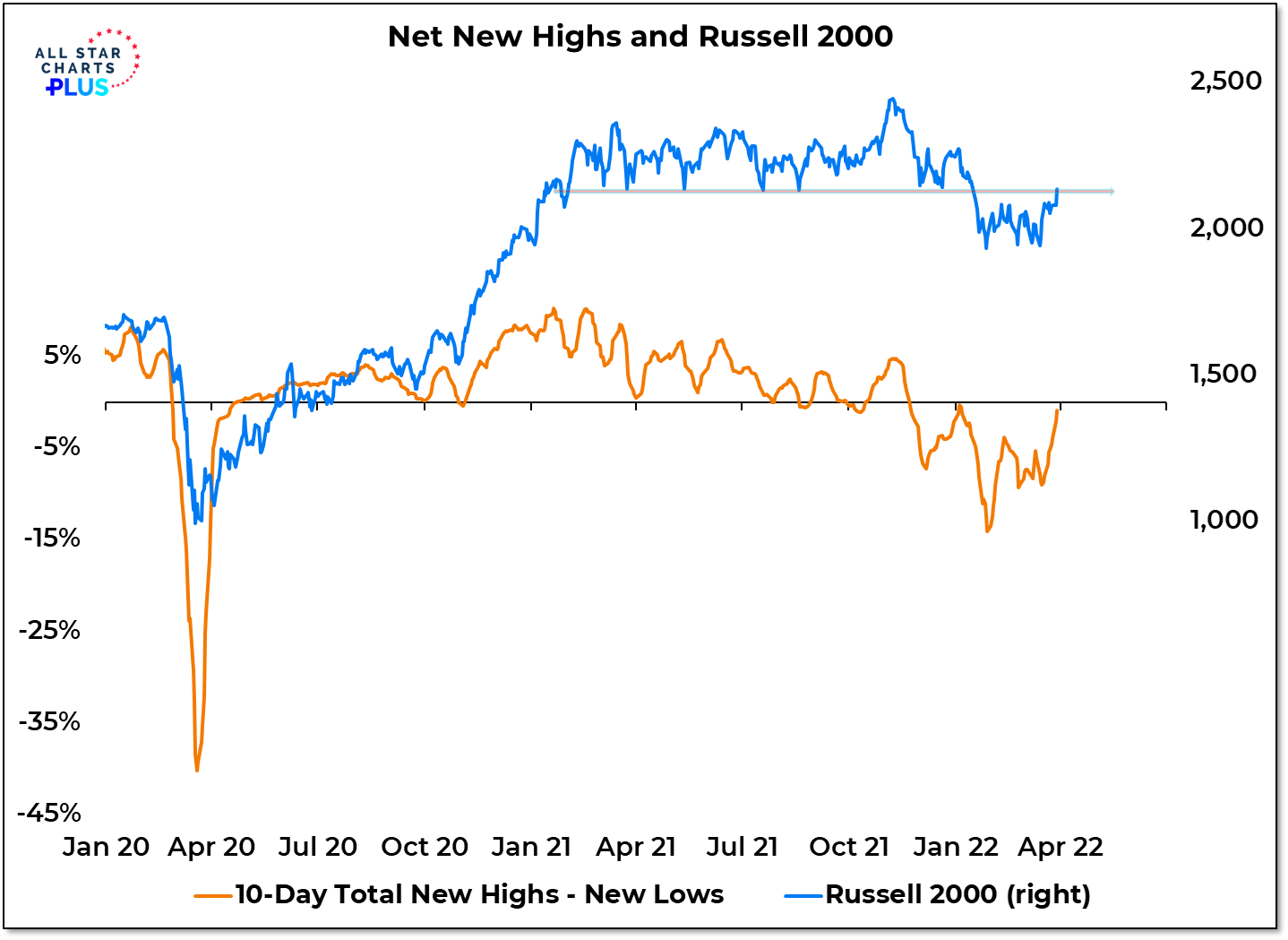
The rally off of the mid-March stock market lows has investors feeling better (or at least less bad). This improved mood (and the rebound in price that helped fuel it) will likely have more staying power if it’s accompanied by a better breadth backdrop. We are heading in that direction, but there is still work to be done. This week we finally had a day with more new highs than new lows (for the first time since the second trading session of the year). Building on that and getting the 10-day net new high number back in positive territory could help small-caps get back in gear. We’ve also had nearly 50% of S&P 500 stocks close at new 20-day highs. Getting above 55% would fire the first breadth thrust in our work since June 2020 and move the market into a bullish breadth thrust regime. The caveat: close but no cigar works in horseshoes and hand grenades but not breadth thrusts. A failure to build on recent strength could be met with disappointment from a price (and then sentiment) perspective.
JC had a great blog post out this week about zooming out. In a nutshell, he was reminding us that zooming out and looking at price action from a wider lens often makes the present murky waters look suddenly clear. It’s easy to get distracted by the day-to-day price action and to look at only the last few months of daily charts and conclude that a stock or an index is in one sloppy clusterjam of price action.
But when you look at that same price action, instead with weekly or monthly candles, the more recent ones will often look like insignificant noise in an otherwise smoothly trending longer term pattern.
In the post referenced above, JC shared several current examples of instruments that look sloppy recently, but the bigger picture is still sitting pretty.
One of the stocks he mentioned is currently giving us a nice pullback to get a nice entry on. [Read more…]
One of the hallmarks of the beginning stages of new trends, irrespective of asset class, is the thrust.
There are many different ways markets can thrust, but it’s commonly one of two:
In Monday’s letter, we discussed that if Bitcoin could close in the green, it’d be the first time it’s seen seven consecutive positive closes since the July short squeeze.
Fast-forward, we’re now sitting on eight with a probability of nine green candles in a row:
The team over at Fox Business asked me to come on this week to talk about what I’m seeing in the market.
In this short clip, I talk to Charles about the Sentiment unwind that we’ve been seeing and whether or not it’s got legs.
I think it does.
Here’s the interview in full. I come in at the 9:35 mark.


