This is the weekly post that aggregates all the charts we put together throughout the week and organizes them all into one, easy to flip through deck.

Expert technical analysis of financial markets by JC Parets
This is the weekly post that aggregates all the charts we put together throughout the week and organizes them all into one, easy to flip through deck.
From the desk of Steven Strazza @Sstrazza and Ian Culley @Ianculley
Commodities are having their best week since 1970. And if you don’t know what happened after that, let’s just say it was a good decade for them as a group.
The CRB Index is up more than 13%. Crude oil is trading above 100. Wheat futures opened limit up last night, “dotting the chart.” Base metals such as aluminum and tin continue to print all-time highs.
And even precious metals have joined the party!
Could it get any more bullish? [Read more…]
From the desk of Steve Strazza @Sstrazza
Our International Hall of Famers list is composed of the 100 largest US-listed international stocks, or ADRs. We’ve also sprinkled in some of the largest ADRs from countries that did not make the market cap cut.
These stocks range from some well-known mega-cap multinationals such as Toyota Motor and Royal Dutch Shell to some large-cap global disruptors such as Sea Ltd and Shopify.
It’s got all the big names and more–but only those that are based outside the US. You can find all the largest US stocks on our original Hall of Famers list.
The beauty of these scans is really in their simplicity.
We take the largest names each week and then apply technical filters in a way that the strongest stocks with the most momentum rise to the top.
Based on the market environment, we can also flip the scan on its head and filter for weakness.
Let’s dive in and take a look at some of the most important stocks from around the world.
From the desk of Willie Delwiche.
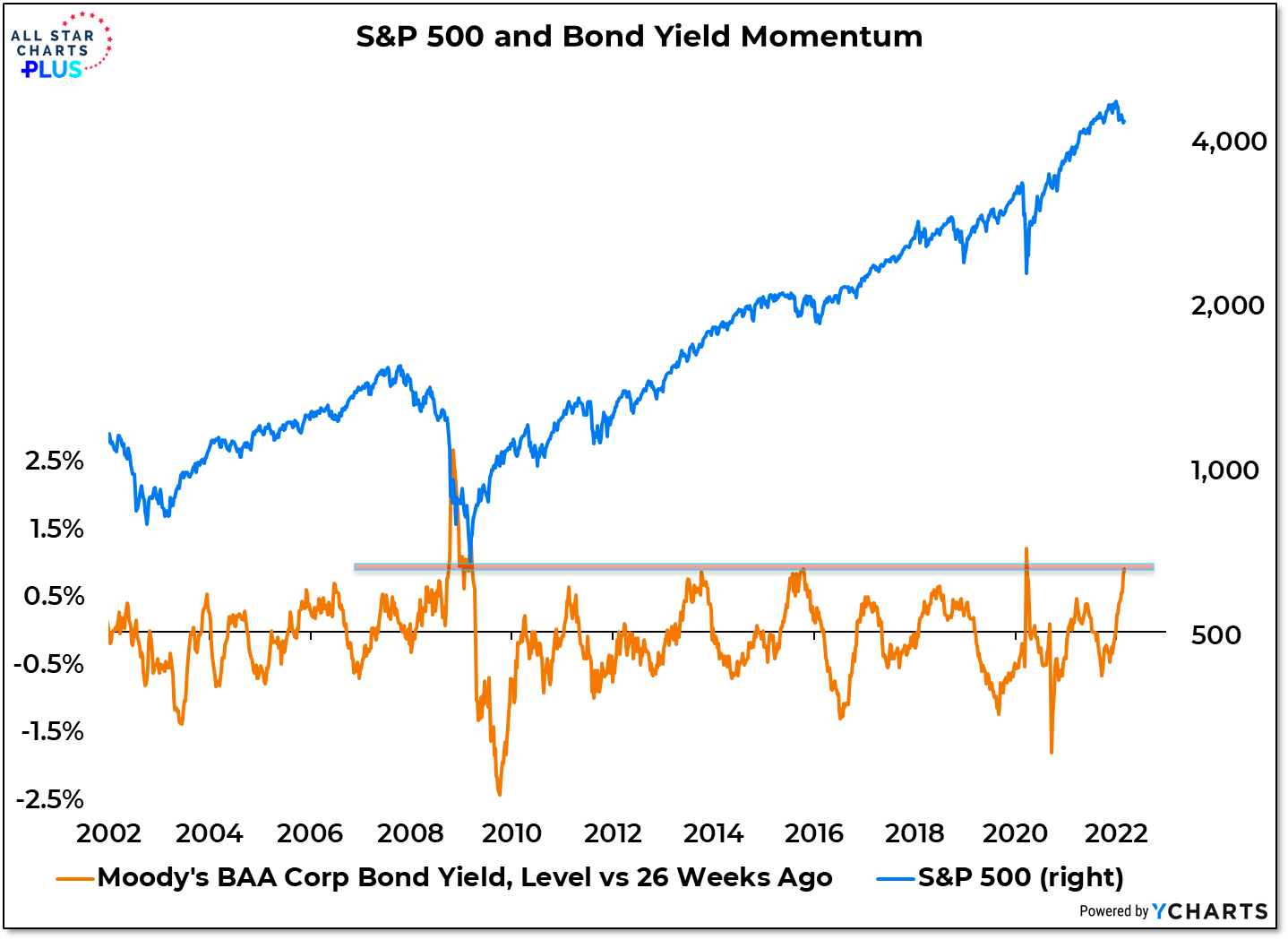
Bond market moves are getting plenty of attention this week. 10-year Treasury yields dropped to levels not seen since the opening trading sessions of 2022 and German yields have dipped back into negative territory (and will again have to contend with resistance at zero). Credit has been slower to react. The Moody’s BAA Corporate yield is just a few basis points off its high and upside momentum remains intact. Except for a brief COVID related blip, the six month change in corporate yields is at its highest level since the financial crisis. This matters because all of the net gains in the S&P 500 over the past twenty years have come when corporate yields have been falling. It has been very difficult for the S&P 500 to make any upside progress when the path for yields has been higher. Even before the Fed has started to raise rates or drawdown its balance sheet, the liquidity backdrop has already deteriorated.
From the desk of Steve Strazza @Sstrazza
Dividend Aristocrats are easily some of the most desirable investments on Wall Street.
These are the names that have increased dividends for at least 25 years, providing steadily increasing income to long-term-minded shareholders.
As you can imagine, the companies making up this prestigious list are some of the most recognizable brands in the world. Coca-Cola, Walmart, and Johnson & Johnson are just a few of the household names making the cut.
Here at All Star Charts, we like to stay ahead of the curve.
That’s why we’re turning our attention to the future aristocrats. In an effort to seek out the next generation of the cream-of-the-crop dividend plays, we’re curating a list of stocks that have raised their payouts every year for five to nine years.
We call them the Young Aristocrats, and the idea is that these are “stocks that pay you to make money.”
Imagine if years of consistent dividend growth and high momentum and relative strength had a baby, leaving you with the best of the emerging dividend giants that are outperforming the averages.
By adding our technical analysis to the mix, the Young Aristocrat setups give you the opportunity to own the best of the market’s future blue-chip winners before they become must-own household names.
Often, the strongest performers in this universe and even the Aristocrats themselves pay relatively small dividends.
This is usually because the stock appreciation makes it tough to keep up with the payout — even for companies that consistently grow their yield in the double-digits!
For this reason, we don’t have a minimum threshold for the dividend. What we’re really doing here is creating a list of quality stocks based on their ability to persistently grow their shareholder return.
And maybe the best part? This list is not just designed for long-term investors. Any kind of investor or trader can use this list as it helps generate ideas across all time frames, even the short term.
Remember, some of the most important filters we use for this list are momentum, relative strength, and proximity to new highs.
So, let’s keep it real: These stocks are going up across all time horizons.
From the desk of Steve Strazza @Sstrazza
Welcome to the 2 to 100 Club.
As many of you know, something we’ve been working on internally is using various bottom-up tools and scans to complement our top-down approach. It’s really been working for us!
One way we’re doing this is by identifying the strongest growth stocks as they climb the market-cap ladder from small- to mid- to large- and, ultimately, to mega-cap status (over $200B).
Once they graduate from small-cap to mid-cap status (over $2B), they come on our radar. Likewise, when they surpass the roughly $30B mark, they roll off our list.
But the scan doesn’t just end there.
We only want to look at the strongest growth industries in the market, as that is typically where these potential 50-baggers come from.
Some of the best performers in recent decades – stocks like Priceline, Amazon, Netflix, Salesforce, and myriad others – would have been on this list at some point during their journey to becoming the market behemoths they are today.
When you look at the stocks in our table, you’ll notice we’re only focused on technology and growth industry groups such as software, semiconductors, online retail, solar, etc.
Then, like any good technician, we filter the list down to those closest to new highs.
This allows the cream of these strong groups to rise to the top and helps streamline our mission to identify technical breakouts in the top-performing stocks.
From the desk of Steven Strazza @Sstrazza and Ian Culley @Ianculley
We could sit back and speculate on what measures the Federal Reserve is likely to take to curb inflation. But it wouldn’t change the fact that inflation is already here.
We’d rather focus on what market participants are doing now to position their portfolios for these inflationary pressures.
Since last year, inflation has gripped markets, and we don’t foresee it going away anytime soon. We think the best course of action is to get used to this environment and focus on assets that tend to perform well during periods of inflation.
One of our favorite ways to measure inflation expectations is by analyzing Treasury Inflation-Protected Securities (TIPS) versus Treasuries.
Relative strength from TIPS implies that investors are positioning themselves for a general increase in the prices of goods and services. That’s exactly what we’re seeing today.
Let’s take a look and discuss what we want to do about it.
I feel like this has been the lead for many blog posts recently, but the trend continues: options volatilities continue to remain elevated across the board with $VIX holding above 30, and this makes me want to continue favoring strategies that are net short options premium.
But with the trade today, we’re going to leverage options premiums to help us finance a bullish bet on NASDAQ stocks.
It started out with JC and I wanting to simply sell premium, but when we looked into $QQQ options it became pretty clear that we could get paid handsomely if recent lows end up becoming a pivot to higher prices and we took some put premiums to buy out-of-the-money calls. [Read more…]


