This is the video recording of the January 2023 Mid-month Conference Call.
[PLUS] Weekly Sentiment Report: Investors Confront Unfamiliar Weakness
From the desk of Willie Delwiche.
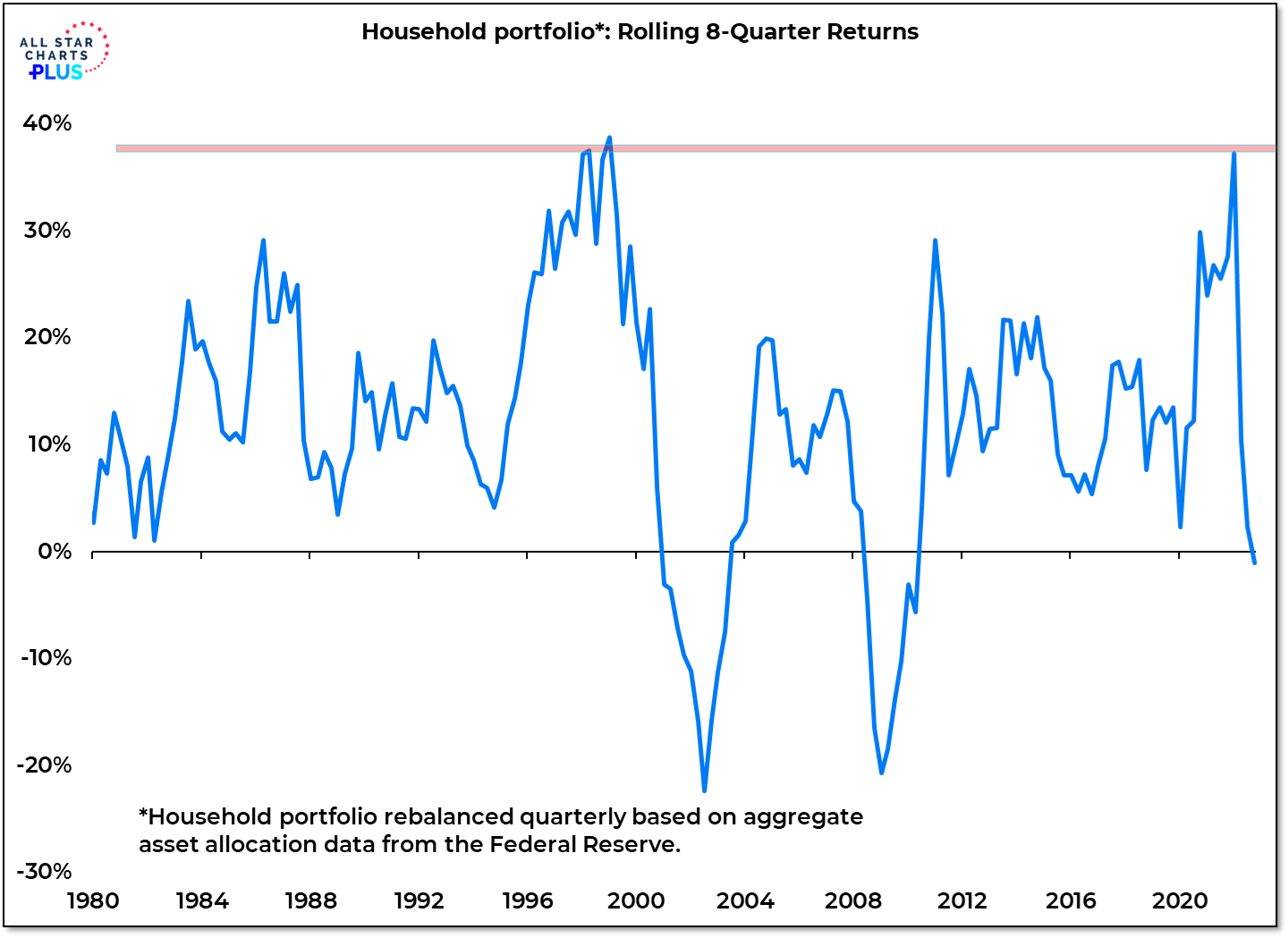
Over the course of 2022, the two-year (8-quarter) return for the aggregate household portfolio dropped from one of the highest levels in over 40 years to underwater for the first time in over a decade.
Why It Matters: Sentiment soured in 2022 but investors largely stuck with their equity exposure. They choose not to meaningfully increase their exposure to bonds or cash (and commodity funds actually experienced outflows last year). Now investors are reviewing portfolios that didn’t just experience a bad year, but are actually down over the past two years. This is unfamiliar territory for a generation of investors who are not used to sustained weakness and who see US large-cap equities as the only game in town.
2022 was a bruising experience for many and 2023 is an opportunity to put aside broken paradigms and embrace forgotten realities. My expectation is that this leads to overdue discussions about proper diversification and adaptive positioning, across and within asset classes. Reach out if you are ready to talk or need help with these important conversations.
In this week’s Sentiment Report we take a closer look at how investors are feeling and what they are doing after a year that brought an unprecedented combination of volatility and weakness.
Buy Tesla
[PLUS] Weekly Sentiment Report: S&P Earnings: Direction > Level
From the desk of Willie Delwiche.
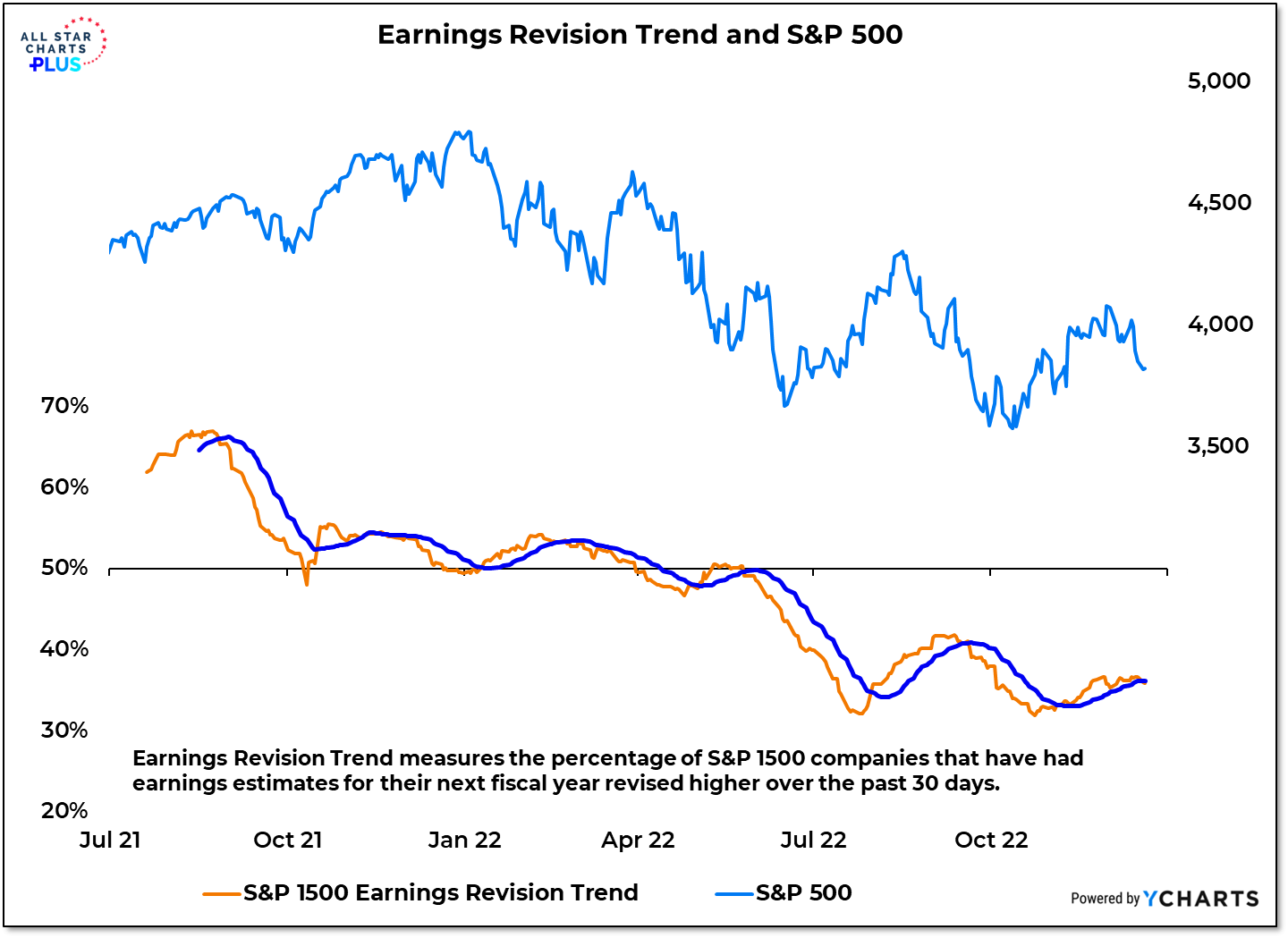
Seems like almost everyone has a 2023 earnings estimate for the S&P 500. The thinking seems to be that if you are going to make up a year-end guess at price you should come up with one for earnings as well. That’s not a game I want to play.
Why It Matters: It’s not the overall levels that matter, but whether those levels are being revised higher or revised lower. Earnings estimates for more and more companies were being revised lower over the second half of 2021 and the first half of 2022. That trend has stabilized since mid-year. If the worst case for 2023 is priced in, there is room for both price and earnings revisions to move higher. If it is not, then the lows established over the second half of 2022 are not likely to hold. Remember, when it comes to adapting to incoming information, it’s not a question of whether it is good or bad, but whether it is better or worse than expected.
In this week’s Sentiment Report we take a closer look at how investors are feeling as they say goodbye to a messy & challenging 2022.
[PLUS] Weekly Sentiment Report: Have Equities Lost It?
From the desk of Willie Delwiche.
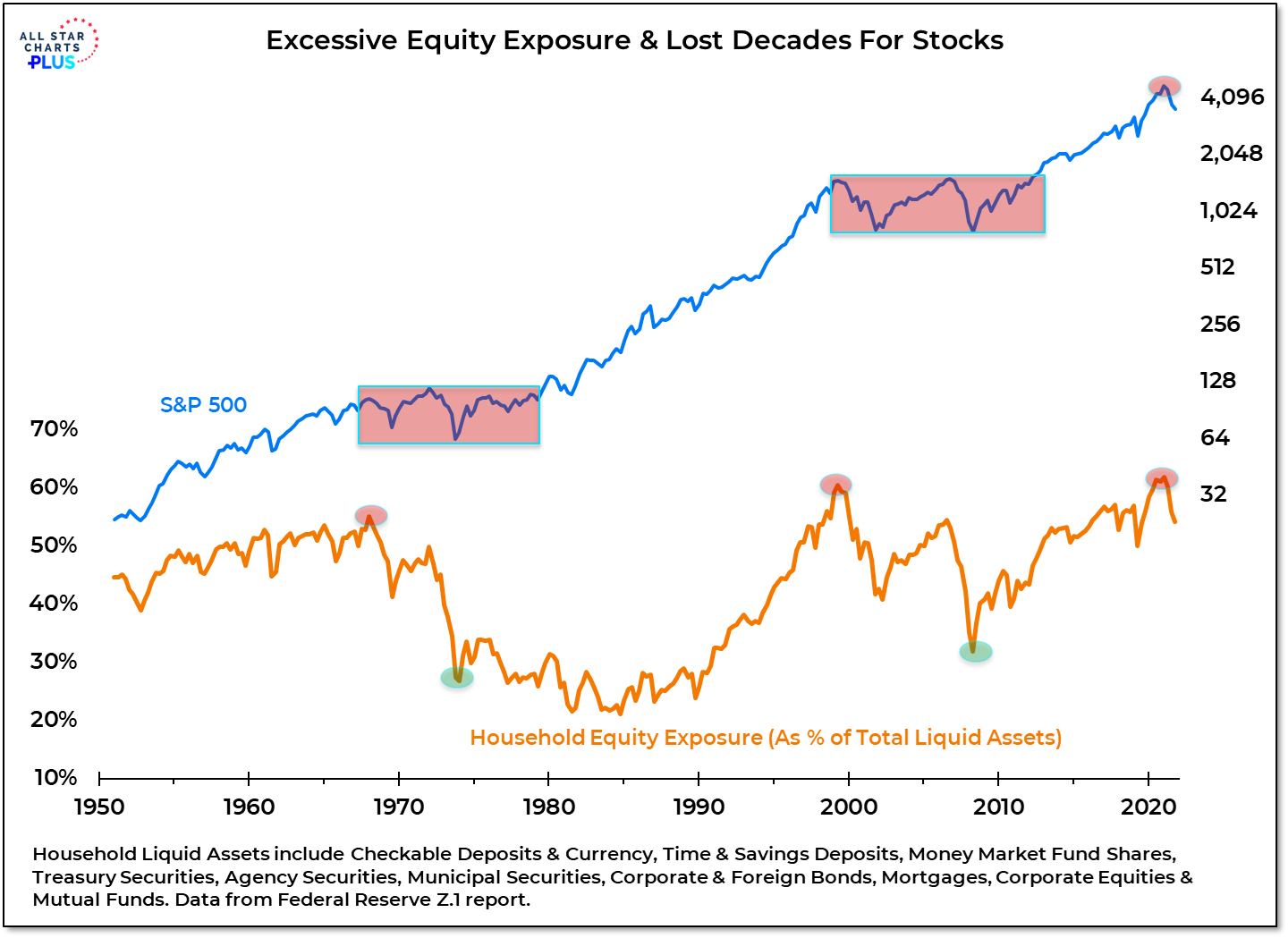
Household equity exposure (as a percentage of total liquid assets) fell again in the third quarter dropping from 56% to 54%. It was at its highest level ever (62%) coming into this year and remains high by historical standards (90th percentile).
Why It Matters: When equity exposure made a new high and then reversed in 2000, it ushered in a lost decade for stocks. The S&P 500 was no higher in late 2012 than it was in early 2000. The same was true in 1968. The S&P 500 was no higher in mid 1979 than it was in late 1968. While stocks were going sideways, household equity exposure was in secular decline. Equity exposure fell from 55% in Q4 1968 to 27% in Q4 1974 (when the S&P 500 bottomed). It dropped from 61% in Q1 2000 to 32% at the stock market low in Q1 2009. From this perspective, 2022 looks less like a one-off decline and more like year 1 of a secular bear market for equities. Opportunities will emerge and fade, but expecting a quick return to the market environment of the past decade seems to defy the lessons of history.
In this week’s Sentiment Report we take a closer look at how investors are feeling in light of their still historically high exposure to stocks.
[PLUS] Weekly Sentiment Report: “Nothing Changes Sentiment Like Price”
From the desk of Willie Delwiche.
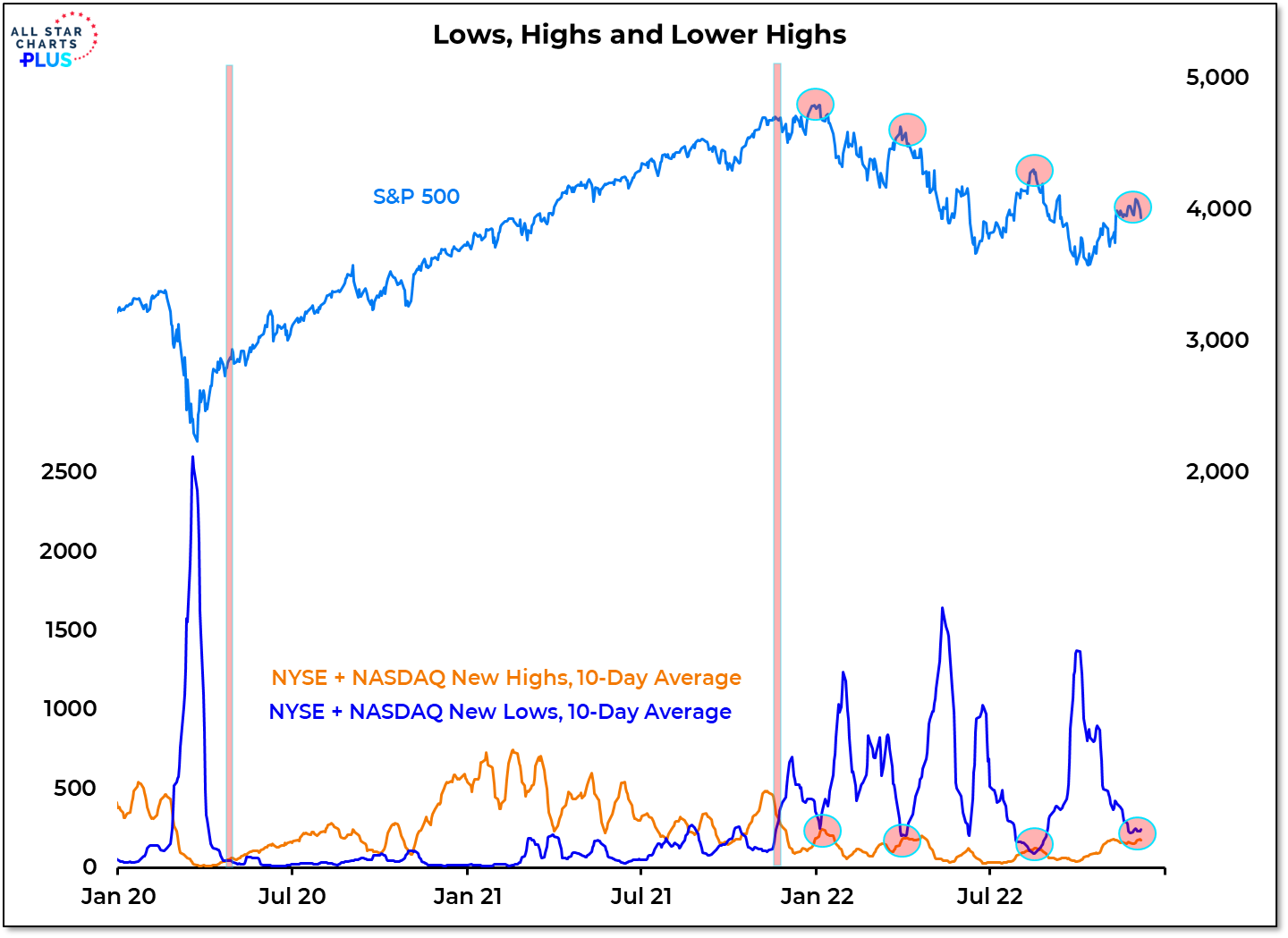
The S&P 500 continues to make lower highs as new lows have approached, but not broken below, new highs. This breadth signal occurred as the S&P 500 was peaking in January. It re-emerged near the March and August highs and appears to be doing so again.
Why It Matters: New high versus new low crossovers are usually fueled more by changes in the new low list than the new high list. New highs edge up slowly in the early stages of a bull market and can peak well before the indexes. The post-COVID bull market was a great example of that. But regardless of the driver, history shows it is important that they take place. As the longest bear market since the Financial Crisis has moved along, investors have been itching to turn more optimistic. But so far the price action (on the surface and below) isn’t doing much to change anyone’s mind or give rise to the increase in bulls needed to have a bull market.
In this week’s Sentiment Report we take a closer look at persistent pessimism and how investors so far haven’t matched word with deed.
[Premium] Monthly Charts Strategy Session December 2022
This is the video recording of our December 5th Monthly Charts Live Strategy Session
People Are Angry…Good!
- « Previous Page
- 1
- …
- 6
- 7
- 8
- 9
- 10
- …
- 25
- Next Page »


